Average NBA Player Height in 2026–27: What 6 Feet 7 Inches Means
Average NBA player height was reported as 6 feet 7 inches for 2026–27 opening-night rosters. Learn who counts and why other averages differ.
On this page
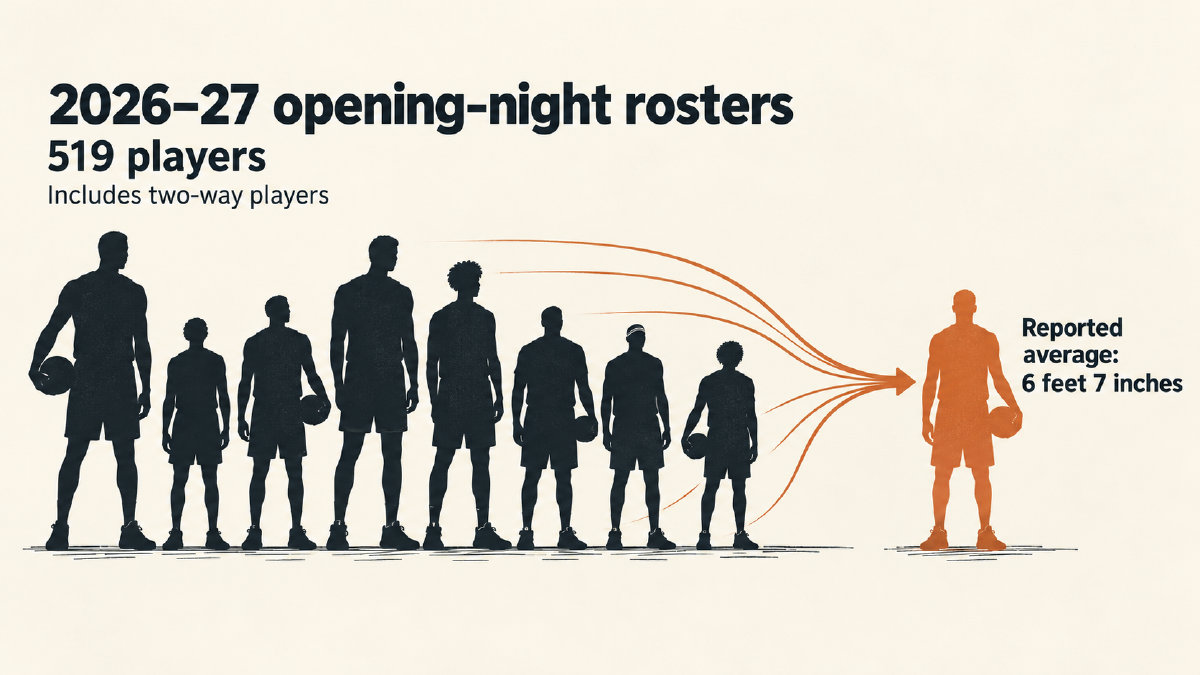
In the 2026–27 NBA season, the league's official average player height is 6 feet 7 inches. That’s the figure in the NBA’s official 2026–27 opening-night roster release, covering 519 players across all 30 teams, including two-way players.
That’s not the only place you’ll see that number, though. It shows up elsewhere, too. For example, here’s an article from The Hoops Geek.
The Hoops Geek’s analysis covers 2025–2026, not 2026–27, and gives an average height of 199.9 centimeters.
And here’s another one from Joker Mag.
So why do we have these different numbers? Why is it sometimes 6 feet 7 inches, and sometimes 6 feet 6.58 inches?
What the NBA’s Official Average Means
Let me start by explaining what the NBA’s own number means. Its opening-night roster release describes the population behind the figure, but it doesn’t include individual height rows for reproducing the average.
To calculate an average yourself, you need each player’s height and a roster list that lets you count each distinct player once.
The release displays the average as 6 feet 7 inches. That doesn’t establish how individual roster heights are rounded, and the release doesn’t provide the unrounded league mean or its rounding procedure.
Calculating Average NBA Player Height
So if you want to calculate an arithmetic average of listed heights for the 2026–27 opening-night roster, you need the individual height rows. That calculation alone wouldn’t establish the NBA’s unrounded mean or rounding procedure. First, you have to convert all the players’ heights into the same unit. Since most of them are given in feet and inches, I’ll convert them all to centimeters. Let’s say there are N players on the NBA’s roster. Each of those players has a certain height, which we’ll call h_i for the i-th player. To calculate the average height, we add up all the players’ heights and divide by the number of players: average height = (h_1 + h_2 + … + h_N) / N.
This is called an arithmetic average. An arithmetic average weights each individual equally, regardless of how many minutes they play or how much money they make. All that matters is who’s on the roster. This is important because if we used minutes played instead of players, we would get a very different answer.
For example, let’s say there are two players on the NBA’s roster. One is a 6’3” center who plays 1 minute per game, and the other is a 7’0” power forward who plays 48 minutes per game. If we calculated their average height using minutes played, we would get (75 × 1 + 84 × 48) / (1 + 48) ≈ 83.82 inches, or about 6 feet 11.82 inches.
But if we calculated it using the number of players, we would get (75 + 84) / 2 = 79.5 inches, or 6 feet 7.5 inches.
That’s a huge difference! In reality, when you’re calculating averages for sports leagues, you usually use minutes played rather than number of players. But in the NBA’s case, they didn’t release the data needed to calculate the minutes-based average. Instead, they just released the raw data, so we had to do our own calculations.
I’ve explained that calculation, but I can’t reproduce the NBA’s reported value of 6 feet 7 inches from the release alone: it doesn’t supply the individual height rows, unrounded mean or rounding procedure.
The NBA’s official value of 6 feet 7 inches converts to 200.66 centimeters, or approximately 201 centimeters. That’s a conversion of the displayed figure, not the unpublished unrounded league mean; the release doesn’t explain its rounding procedure.
The NBA also includes two-way players in their roster snapshot. Two-way players are essentially players who are signed to both the G League and the NBA. As such, they count toward both teams’ rosters. This is probably why the NBA reports the total number of players as 519, even though there are only 30 teams.
Why Sources Report Different Average Heights
Now, I should mention that the NBA isn’t the only source reporting the average height of NBA players in the 2026–27 season. There are also a couple of secondary sources. For instance, here’s a report from The Hoops Geek.
Here’s another one from Joker Mag.
These numbers differ slightly from the NBA’s own. The Hoops Geek reports that the average height was 6 feet 7 inches, while Joker Mag reports that it was 6 feet 6.58 inches. Why the discrepancy?
Well, the NBA’s number comes from their own roster snapshot, but the other two numbers come from separate sources. The Hoops Geek says that their number comes from basketballreference.com, while Joker Mag says that theirs comes from Stathead. Both of those sites are third-party websites that aggregate statistics from across the NBA. The Hoops Geek points readers to its raw data source and mentions a CSV export option, though that alone doesn’t tell us exactly how each average was calculated.
However, there are a few clues we can glean from these reports. First, the NBA’s number is based on the entire roster, whereas the others seem to be based on samples. The Hoops Geek mentions that they used the 2025–2026 season’s data, and Joker Mag mentions that they used a sample of 456 active players. These samples could have been taken at different times during the season, and they might have excluded some players.
Second, the NBA’s release doesn’t specify how its average is weighted. The Hoops Geek describes a height distribution by minutes played, but that doesn’t establish how its headline average is weighted. Joker Mag’s quoted statement doesn’t specify weighting either. So we can’t isolate weighting as the reason these averages differ.
Third, the NBA’s number is based on barefoot measurements, whereas the others aren’t necessarily. The NBA says that they measure players’ heights without shoes, but it doesn’t say whether they take fresh measurements for each player. NBA.com published an Associated Press report documenting the official barefoot measurement policy introduced before 2019–20. That tells us when the policy started, but it doesn’t establish that this season’s roster was measured again. Some people think that the NBA’s number is based on a new measurement of each player’s height, but I’m not sure.
The overall average also hides differences between positions. The Hoops Geek reports different 2026 averages for point guards and centers, but those aren’t official 2026–27 figures. Their study assigns each player one position per season, even though players can fill multiple roles.
Unanswered Questions About the NBA’s Average
There are a lot of unanswered questions about the NBA’s average player height in the 2026–27 season. We don’t know exactly how the NBA arrived at their number, nor do we know exactly how the other sources arrived at theirs. We don’t even know exactly what the NBA’s number represents. It could be based on the overall mean, or it could be based on some kind of weighted average. And we don’t know whether the NBA takes fresh measurements of each player’s height, or whether they just use old measurements.
Ultimately, we’ll never know for sure. The NBA hasn’t released any more information about their number, and the other sources haven’t released any more information about theirs either.
Sources
Try the height tools
Compare two to ten people or convert a height precisely.
Compare heights →Height converter →Related articles
How to Find 5 8th of an Inch on a Ruler
Find 5 8th of an inch on a ruler: 5/8 is halfway between 1/2 and 3/4 inch, at the fifth eighth-inch or tenth sixteenth-inch division.
Read articleFeet Versus Inches: How to Read Height Measurements
Understand feet versus inches: one foot equals 12 inches. Read ft, in, ′ and ″ correctly, and distinguish decimal feet from feet-and-inches heights.
Read article