How Is Height Measured at Home and in a Clinic?
How is height measured? Learn how a stadiometer works and how to use a wall and tape measure, position yourself, and record a home reading.
On this page
Height is measured using the same method whether you measure it at home or in a clinic. The difference is that when measuring height in a clinic, the person doing the measuring will use a stadiometer, which is basically a long ruler attached to the wall. It has a sliding horizontal headpiece that rests on top of your head.
At home, you can do this with a tape measure, but it’s important to make sure that your measurements are as accurate as possible. You’ll need to take a few extra steps to get an accurate measurement.
Measuring Standing Height
The most basic way to measure standing height is to have the person stand upright with their back against a flat wall. Then, place a level on top of their head so that it touches the wall. Mark where the level meets the wall, then remove the level, and measure from the floor to the mark. This will give you the person’s standing height.
You can also use a small object like a cereal box and place it on top of their head while they stand with their back against a flat wall. Then, mark the wall where the bottom of the cereal box (or whatever object you used) meets the top of their head, and measure from the floor to that mark to get their standing height.
Preparing for an Accurate Measurement
There are some things you can do to help ensure that your measurement is accurate:
Make sure the floor is flat and uncarpeted. A carpeted floor can cause the person’s feet to sink into the floor slightly, making their height appear shorter than it really is.
Make sure the wall is flat and has no molding around it. If there is molding, you may not be able to get the person’s head all the way up against the wall.
Remove any shoes or other interfering hair arrangements or headwear before taking the measurement.
Measuring Height at Home Step by Step
Now, let’s walk through the process of measuring someone’s height at home. I’m going to go step by step, and I’ll explain how each step helps to get the most accurate reading possible.
First, you want to have the person stand upright with their back against a flat wall. Their feet should be flat on the floor, and their heels should be at the junction of the wall and the floor. They should be standing straight, looking straight ahead, and keeping their line of sight and chin parallel to the floor. It’s very important that their head, shoulders, and buttocks are all toward the wall.
If you’re measuring a child, you may find that it’s difficult to get them all the way up against the wall. That’s okay. You just want to get them as close as possible, even if they don’t quite touch the wall. When measuring children, it’s also a good idea to have them wear snug-fitting clothes, since loose clothing can affect accuracy.
Next, you’ll need to get a flat headpiece. This could be a ruler, a hardcover book, or any other flat object that can be placed on top of the person’s head. Place the headpiece on top of the person’s head so that it’s touching the wall. If you’re using a ruler, you’ll probably want to keep it as straight and flat as possible. Hold the headpiece at a right angle to the wall and lower it onto the person’s head before marking.
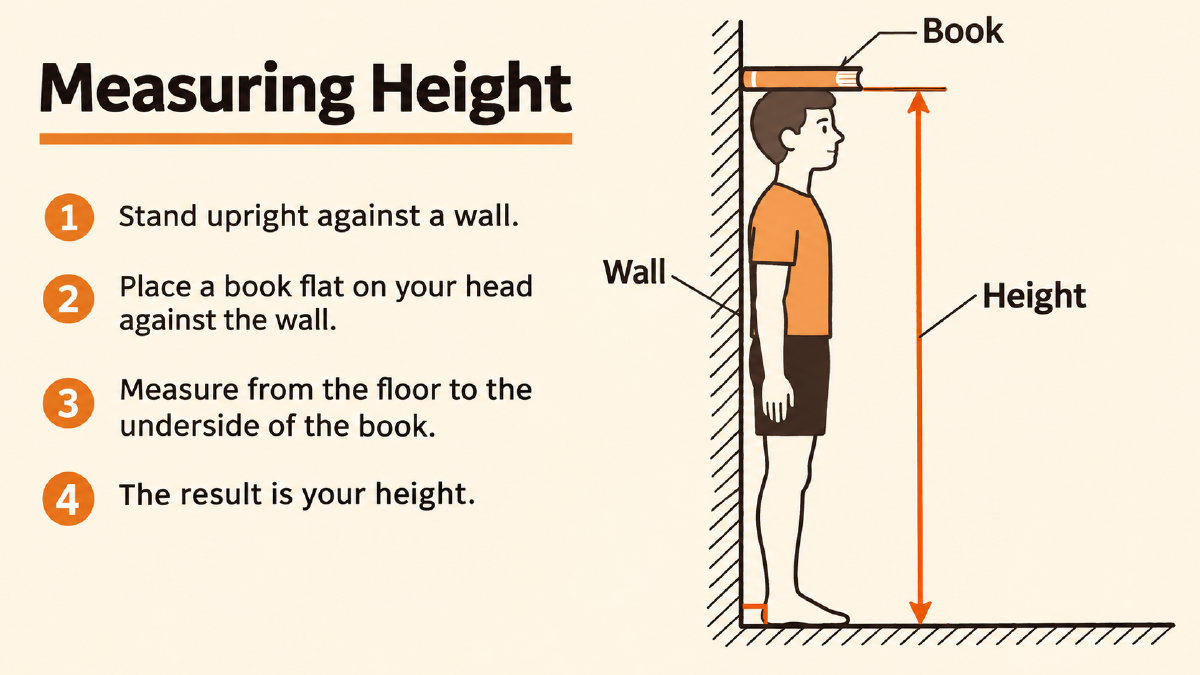
Then, place a pencil or marker on the end of the headpiece, right at the point where it’s touching the wall. This will indicate where the top of the person’s head is located.
Now, remove the headpiece and measure from the floor to the pencil mark on the wall. That’s the person’s height.
Measuring Yourself Without Assistance
This is how Healthline measures height at home. But what if you don’t have someone else to assist you? There’s still a way to do it. Just remember that it’s harder to keep the ruler or book perfectly straight and flat when you’re alone. So you might want to place a mirror on the wall to help you keep it steady.
Also, it’s easier to get a clear view of the headpiece if you have a mirror, so you can check to make sure that it’s parallel to the floor. And finally, if you’re measuring yourself, you’ll probably want to hold one hand steady while marking the wall, and use the other hand to hold the headpiece.
But again, it’s much easier to have someone else do it for you.
Recording Height Measurements
Healthline recommends measuring height to the nearest 1/8th inch or 0.1 centimeter. But just because you record a measurement to the nearest 1/8th inch doesn’t mean that your home measurement is necessarily more accurate than a measurement done in a clinic. Remember, the equipment and positioning aren’t guaranteed to be accurate at home. The only thing we know for sure is that the recording increment is precise.
So why do we recommend measuring height to the nearest 1/8th inch or 0.1 centimeter? Because the more precise you are with your numbers, the more consistent your results will be. For example, if you measure someone’s height once, and then later measure them again, the more consistent your results will be if you record the number to the nearest 1/8th inch or 0.1 centimeter.
Timing and Consistency
And finally, it’s a good idea to note the time when you took the measurement. Why? Because researchers who have studied the reliability of height data have found that diurnal variation may substantially affect the reliability of height data. In fact, in a study of 53 children, two independent auxologists measured height four times during the day, at 0900, 1100, 1300, and 1500 hours. Both groups used the Leicester height measure, and both groups used the unstretched and stretched techniques. During the study, they observed time-related changes in the children’s heights. Based on their findings, they concluded that repeat-measurement timing warrants consideration.
In short, consistency is key. Remove shoes and any interfering headwear before taking the measurement. Make sure you’re using the same flat, uncarpeted floor. Keep your posture upright and your headpiece aligned correctly. Use a straight tape measure. And always use the same method for measuring from the floor to the mark. And if you want to make sure your data is reliable, record the time when you took the measurement.
Sources
Try the height tools
Compare two to ten people or convert a height precisely.
Compare heights →Height converter →Related articles
Average NBA Player Height in 2026–27: What 6 Feet 7 Inches Means
Average NBA player height was reported as 6 feet 7 inches for 2026–27 opening-night rosters. Learn who counts and why other averages differ.
Read articleHow to Find 5 8th of an Inch on a Ruler
Find 5 8th of an inch on a ruler: 5/8 is halfway between 1/2 and 3/4 inch, at the fifth eighth-inch or tenth sixteenth-inch division.
Read articleFeet Versus Inches: How to Read Height Measurements
Understand feet versus inches: one foot equals 12 inches. Read ft, in, ′ and ″ correctly, and distinguish decimal feet from feet-and-inches heights.
Read article