How to Say and Write Your Height in Metric
Learn to say and write height in metric: use centimeters or meters, read decimal meters correctly, and match the units a form requests.
On this page
I’m not a fan of metric measurements. I prefer American units. But when I need to convert my height from feet and inches to centimeters or meters, it’s usually because I’m filling out a form that requires metric.
So how do I go about converting my height?
Height in Metric in Centimeters or Meters
Let me start by explaining the difference between centimeters and meters as two scales for the same height. When you’re asked to report your height in metric, they’ll either ask for it in centimeters or in meters. The unit of measure determines how you enter it into the form. For example, if they ask for your height in centimeters, then you’d write 175 (as in, 175 cm). If they ask for your height in meters, then you’d write 1.75 (as in, 1.75 m). And remember that 100 cm = 1 m, so those are just two ways of expressing the same thing.
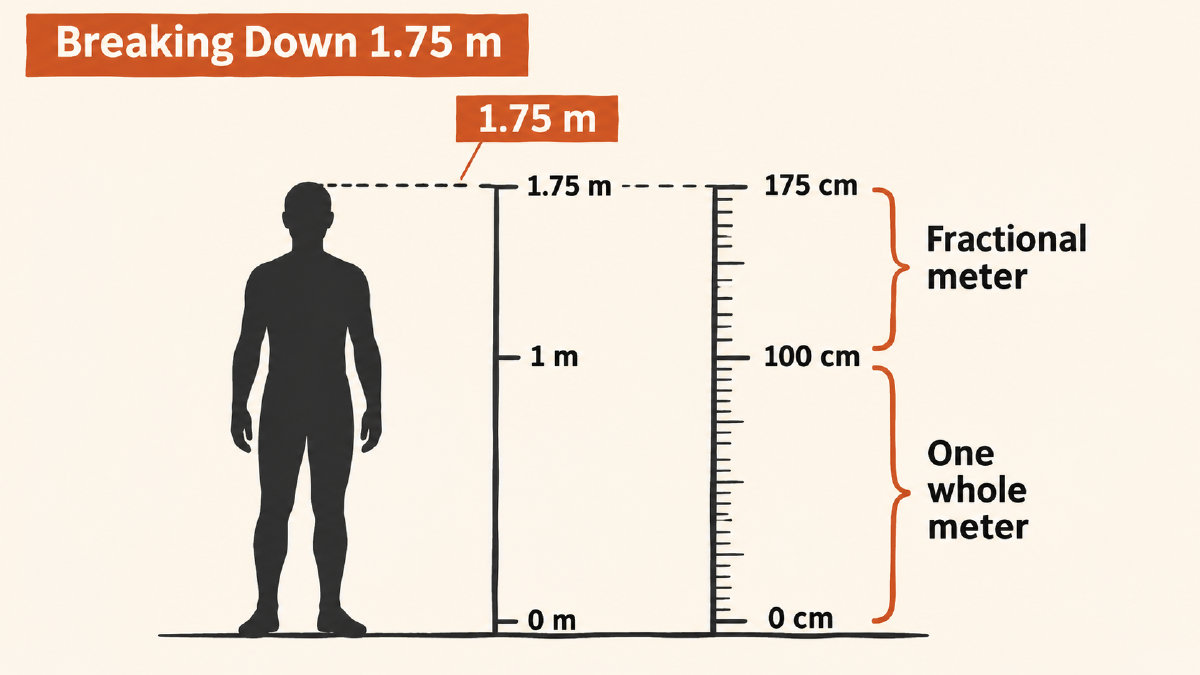
But when you want to write it down, there’s more than one way to express your height in metric. Let’s use 175 cm as our example.
The first is number–symbol spacing. That means that there should be a space between the number and the symbol. So we would write “175 cm” rather than “175cm.” That’s pretty simple.
Next, the symbols themselves should be lowercase. You can’t have an uppercase letter like “M” or “C.” Also, since these are units of measure, you don’t pluralize them. So you’d write “cm” and “m,” not “cms” or “ms.”
Also, keep in mind that in American English, we use a decimal point as our separator. So “175 cm” is correct, but “175,cm” would be incorrect. Also, if you were using decimal meters, you’d write “1.75 m,” not “1.75m.”
Now, here’s where people often get confused. The prefix c joined directly to the m changes meters to centimeters. A centimeter is one hundredth of a meter. It’s still centimeters. So “cm” remains unchanged. Similarly, “m” remains unchanged. So even though “m” is the abbreviation for meter, you never change it to “metre” when writing in metric.
How to Read Your Height Aloud
Now, let’s look at how to read this aloud. In spoken English, you might say, “one hundred seventy-five centimeters.” But if you’re reporting in meters, then you could also say, “one point seven five meters.” And if you’re mixing both, you could also say, “one meter seventy-five centimeters.”
These are three expressions of the same length.
Converting Between Centimeters and Meters
Now, how do we arrive at decimal meters? Well, we need to understand place value. One meter equals 100 centimeters. So if you wanted to represent 70 centimeters in meters, you’d divide by 100. 70 divided by 100 is 0.7. Therefore, 0.7 meters is equal to 70 centimeters.
Similarly, if you wanted to convert 170 centimeters to meters, you’d divide by 100. 170 divided by 100 is 1.7. So 1.7 meters is equal to 170 centimeters. But notice that the decimal point isn’t really changing anything. The digits after the decimal point are simply representing the fractional part of a meter.
And if you wanted to convert 107 centimeters to meters, you’d divide by 100. 107 divided by 100 is 1.07. So 1.07 meters is equal to 107 centimeters.
So the key is understanding that the decimal meters aren’t actually centimeter digits appended to a whole-meter value. A decimal meter is simply a fraction of a meter. It’s directly related to the number of centimeters. Multiply the value in meters by 100, and you get centimeters.
That said, when converting from centimeters to meters, you can always add the appropriate number of zeros to make the conversion easier. For instance, if you wanted to convert 142 centimeters to meters, you could do it one of two ways:
-
Divide 142 by 100. 142 ÷ 100 = 1.42
-
Start with 142, written as 142.0. Then move the decimal point two places to the left. 142.0 → 1.42
Either way, you end up with 1.42 meters.
When you convert from meters to centimeters, you simply multiply the number of meters by 100. For instance, if you wanted to convert 1.75 meters to centimeters, you’d multiply 1.75 by 100. 1.75 × 100 = 175. So 1.75 meters is equal to 175 centimeters.
Using the Site’s Height Converter
So now you know exactly how to convert between centimeters and meters. But what if you need to convert from centimeters to feet and inches, or from meters to feet and inches?
You can use the site’s converter to convert from centimeters to feet and inches, or from meters to feet and inches. Just click on the link below to go to the converter page.
/height-converter
On the converter page, you can choose to convert from Centimeters (cm) to Meters (m), or from Feet & inches (ft / in) to Total inches (in). Or you can choose to convert from Centimeters (cm) to Feet & inches (ft / in), or from Meters (m) to Feet & inches (ft / in).
Centimeters (cm)
Total inches (in)
Feet & inches (ft / in)
Meters (m)
Meters (m)
Feet & inches (ft / in)
Centimeters (cm)
Total inches (in)
So you can convert in either direction.
Now, I’m not going to tell you how to convert from feet and inches to centimeters or meters, because I’ve already written several articles on that subject. However, if you need help converting from feet and inches to centimeters or meters, then please leave a comment letting me know which topic you’d like to see next.
Sources
Try the height tools
Compare two to ten people or convert a height precisely.
Compare heights →Height converter →Related articles
What Level of Measurement Is Height? Why It Uses a Ratio Scale
What level of measurement is height? Learn why numerical height uses a ratio scale, what true zero means, and when height categories are ordinal.
Read articleHow to Read Height Measurement in Mexico
Understand height measurement in Mexico through official metric units, decimal-meter examples, and the documented phrase “un metro 14.”
Read articleA Feet and Inches Calculator Excel Users Can Build on Windows
Build a feet and inches calculator in Excel for Windows with numeric inputs, total inches, height differences, and normalized feet-and-inches results.
Read article