What Level of Measurement Is Height? Why It Uses a Ratio Scale
What level of measurement is height? Learn why numerical height uses a ratio scale, what true zero means, and when height categories are ordinal.
On this page
What level of measurement is height? Height is measured as ratio data. The height value can be ordered, with equal increments between the values. But the key characteristic of ratio measurement is that it has meaningful ratios.
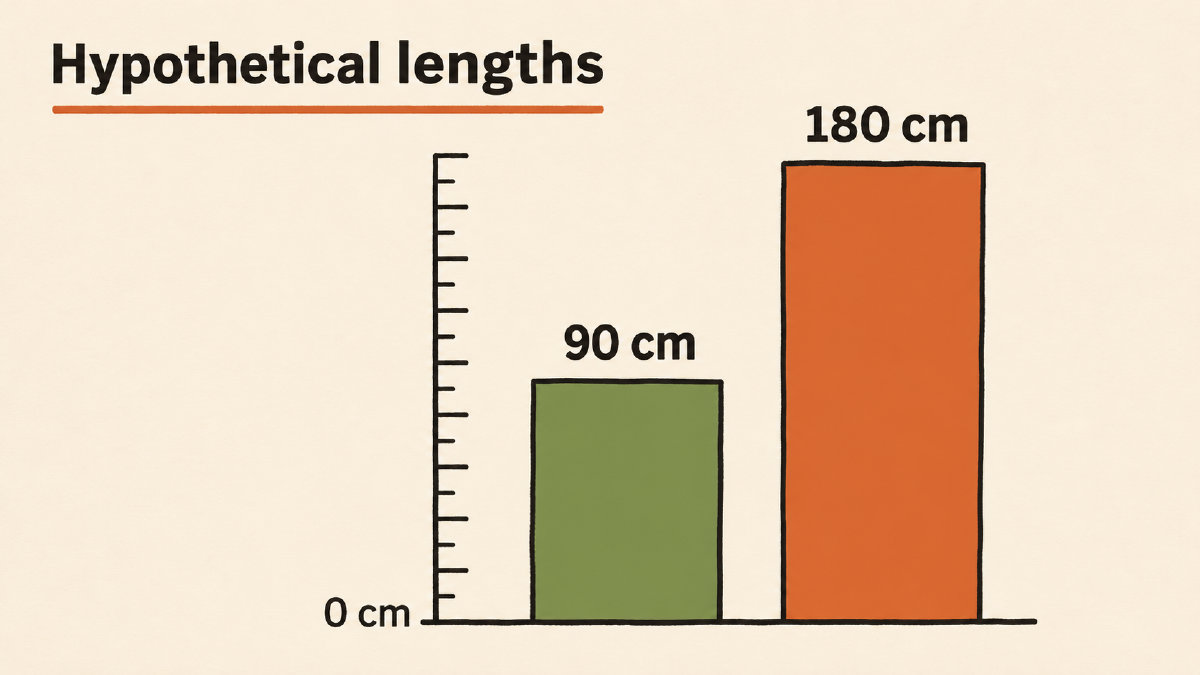
For example, if someone has a height of 180 cm, then their height is double the length of someone who is 90 cm tall. So, the numerical difference in height is important (equal numerical increments) and the actual numerical value matters too. In this case, the 180 cm person has twice the length of the 90 cm individual, meaning there’s a meaningful ratio here.
A zero value for height indicates no length at all. This doesn’t require you to see a person with a height of zero to determine the validity of the zero value. Instead, the zero point on the scale reflects the absence of a measurable property. In this case, the zero point is defined by the lack of any length at all.
Why Height Is Ratio Rather Than Interval
This brings us to the question of whether height is interval or ratio data. An interval measurement allows you to calculate the difference between two values, but not a ratio. For example, a temperature of 20°C is not twice as hot as 10°C — Celsius temperatures don’t have an absolute zero point. However, a difference of 10 degrees represents an equal change in temperature regardless of where on the scale the measurement was taken. That’s what makes Celsius an interval measurement, rather than a ratio one.
The unit of measurement also affects how you treat the level of measurement for height. Changing units (e.g., centimeters vs. inches) doesn’t affect its measurement level, because both measurements are multiplied by the same positive conversion factor. The relationship between the measurements remains the same, so the measurement level of the variable stays constant.
Height Recorded as an Ordered Category
When measuring height, the term “height” implies something that is quantified and has a numerical value. This isn’t necessarily the case for height recorded as an ordered category, such as short, medium, or tall. In that instance, you’re recording a label, not a measurement. The category might imply a certain rank order, but the labels themselves don’t necessarily specify the exact amount or equal gaps between the categories. You could argue, however, that the categories do define the levels of height being recorded, which may imply that they are ordinal measurements. Nominal labels have no inherent order; a nominal variable simply defines a group.
Height, when measured numerically, refers to a continuous quantitative data set, but also falls into the category of ratio data. Continuous quantitative variables can take on infinite values within a given range. Height can technically be categorized as a discrete quantity, as well, depending on how the data is collected. A person can measure their own height using a measuring tape, or have it measured by others, either directly or via other means. In these scenarios, a person’s height can take on any value between a given lower and upper limit, making it a continuous quantity.
While the terms can refer to different classifications, they can be used to describe the same measurements. The numerical height of an object can refer to a continuous quantitative variable. Alternatively, the same height measurement can be classified according to the scale’s properties, indicating it is a ratio measurement.
Sources
Try the height tools
Compare two to ten people or convert a height precisely.
Compare heights →Height converter →Related articles
How to Read Height Measurement in Mexico
Understand height measurement in Mexico through official metric units, decimal-meter examples, and the documented phrase “un metro 14.”
Read articleA Feet and Inches Calculator Excel Users Can Build on Windows
Build a feet and inches calculator in Excel for Windows with numeric inputs, total inches, height differences, and normalized feet-and-inches results.
Read articleHow to Read Height Measurement on Scale Rods: 402KL Markings
Learn how to read height measurement on scale rods using the 402KL's inch and centimeter markings, including its ⅛-inch and 1 mm graduations.
Read article