How to Read Height Measurement in Mexico
Understand height measurement in Mexico through official metric units, decimal-meter examples, and the documented phrase “un metro 14.”
On this page
When I was growing up, we used feet and inches. When I got older, I learned about metric measurements, but I never really used them. Then when I started traveling internationally, I found myself using metric measurements more often.
But when I travel to Mexico, I find that they use the metric system for most things, but not height. In fact, I’ve never seen a height measurement listed in meters or centimeters. So how do you read height measurements in Mexico?
Height Measurement in Mexico
I did a quick search on Google for “how to read height measurement in Mexico,” and it turns out that people are confused about this. Mexico has an official measurement standard that covers height, but I did find one document from the Secretaría de Economía (which is the Mexican government agency responsible for economic policy) called NOM-008-SE-2021: Vigente, which says:
“The unit of length shall be the meter (m), and the following prefixes may be used: deci (d), centi (c), milli (m).”
So while this document covers more than just height, it does say that meters and centimeters are acceptable ways to express height. That said, I also found this example from Sports Illustrated México listing the heights of Lionel Messi and Alexis Sánchez as 1.70 m and 1.69 m respectively.
Converting Between Meters and Centimeters
So if you see a height measurement listed in meters, it should be straightforward. If you want to convert it to centimeters, you just multiply by 100.
But what if you’re given a height in centimeters? How would you know whether it’s supposed to be converted to meters, or if it’s already in meters? For example, let’s say someone tells you that they’re 170 cm tall. Do you convert that to 1.70 m, or is it already in meters?
The answer is that you convert it to meters. The reason why is because the word “centi” means “one hundredth.” And since “centi” is a prefix, it’s a factor of 10^-2. That means that “centi” reduces the value by a factor of 100. So when you have something measured in centimeters, you can divide by 100 to get it into meters.
For example, if you have 170 cm, you can divide by 100 to get 1.70 m. But if you have 1.70 m, you can multiply by 100 to get 170 cm.
Decimal Comma or Decimal Point
That brings me to another point. Why is 1.70 m equivalent to 170 cm? It comes down to the units and decimal notation. Let me explain.
Decimal notation allows us to write numbers in different forms. The key thing to remember is that we can use either a decimal comma or a decimal point to separate the whole number part of the number from the fractional part of the number. This is permitted under the standard (NOM-008-SE-2021).
So in the example above, we could write 1,70 m or 1.70 m. Both mean the same thing. So when you see a number like 1.70 m, you can interpret it as 1.70 meters, or 1.70 x 100 = 170 centimeters. But if you see a number like 170 cm, then you need to divide by 100 to get it into meters, so 170 cm ÷ 100 = 1.70 m.
Check the Unit Requested
This leads me to yet another point. If you see a number like 170, and you’re being asked to input your height in centimeters, then you’ll probably be expected to type 170 rather than 1.70. But if you see a number like 1.70, and you’re being asked to input your height in meters, then you’ll probably be expected to type 1.70 rather than 170.
In other words, the numerical value changes based on the unit requested. You can’t just assume that if you see a number like 170, that it’s 1.70 meters. You need to check the form and the unit to determine how to interpret it.
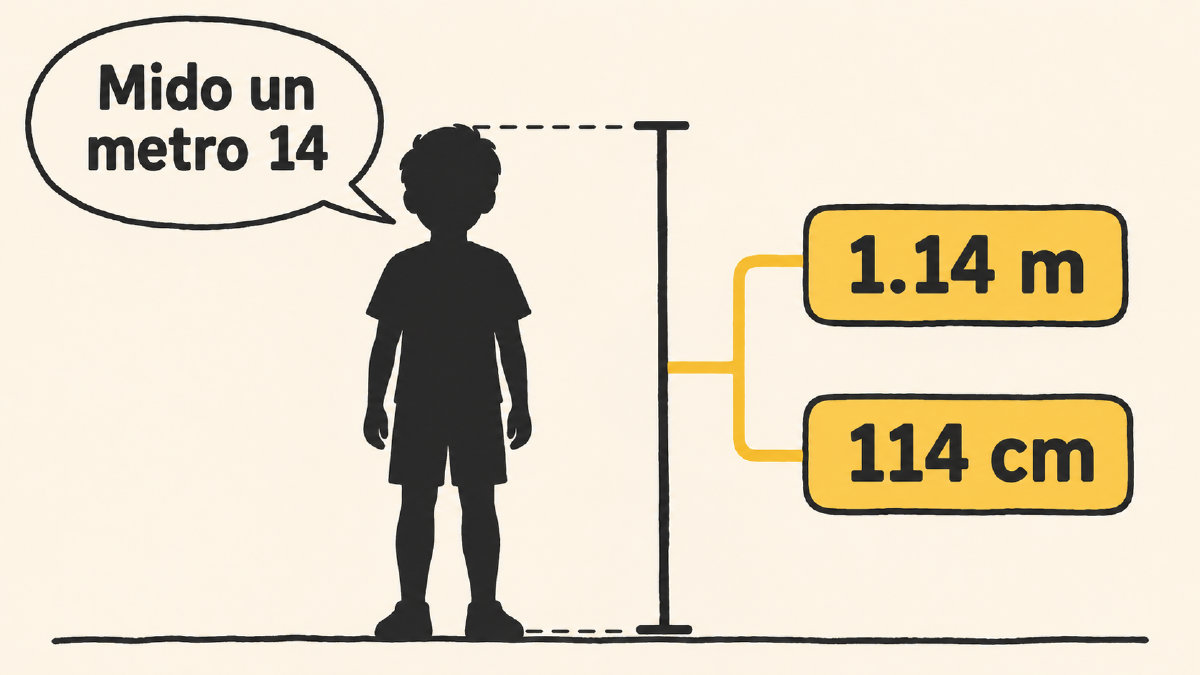
This is also true when you see a number like 1.70. If you’re being asked to input your height in meters, then 1.70 is fine. But if you’re being asked to input your height in centimeters, then 1.70 isn’t right. It needs to be 170. You might also hear someone say “Mido un metro 14.” El Imparcial pairs this expression with a height of 1.14 metros. That means one meter and fourteen centimeters, or 1.14 m, or 114 cm.
Converting Feet and Inches to Metric
So now I’m going to show you an example of how this works with US-to-metric conversions. Suppose you’re 5 feet 7 inches tall. To convert that to metric, you first convert to total inches.
5 ft x 12 in/ft = 60 in
60 in + 7 in = 67 in
Then convert inches to centimeters.
67 in x 2.54 cm/in = 170.18 cm
Now convert centimeters to meters.
170.18 cm ÷ 100 = 1.7018 m
So your height is 1.7018 meters, or 170.18 centimeters.
If you’d like to convert any height between inches, feet & inches, centimeters, and meters, you can use the converter at my website.
Sources
- ¿Cuánto mide Abelito, el influencer de La Casa de los Famosos México?
- DOF - Diario Oficial de la Federación
- NOM-008-SE-2021 – Normalización
- Calculadora de Altura en Pulgadas - Elija su unidad de entrada y obtenga una conversión instantánea y precisa a pulgadas
- ¿Cuánto mide "Chicha" Sánchez? La estatura del jugador de Tigres y los futbolistas más bajos del mundo
Try the height tools
Compare two to ten people or convert a height precisely.
Compare heights →Height converter →Related articles
What Level of Measurement Is Height? Why It Uses a Ratio Scale
What level of measurement is height? Learn why numerical height uses a ratio scale, what true zero means, and when height categories are ordinal.
Read articleA Feet and Inches Calculator Excel Users Can Build on Windows
Build a feet and inches calculator in Excel for Windows with numeric inputs, total inches, height differences, and normalized feet-and-inches results.
Read articleHow to Read Height Measurement on Scale Rods: 402KL Markings
Learn how to read height measurement on scale rods using the 402KL's inch and centimeter markings, including its ⅛-inch and 1 mm graduations.
Read article