What Is Metric and Imperial Measurement? Height Units Explained
Understand metric and imperial measurement through height units, decimal relationships, exact length conversions, and the US customary distinction.
On this page
Three common physical measurements are length, mass, and volume. In the metric system, those are measured using meters for length, grams for mass, and liters for volume. In the British imperial and US customary measurement systems (related but distinct systems), those are measured using inches and feet for length, ounces and pounds for mass, and pints and gallons for volume.
How Measurement Units Relate
The difference in how these units relate to each other is significant. For instance, you can convert between meters and centimeters easily because they’re related by powers of ten. However, the relationship between an inch and a foot is not a power of ten — instead, there’s exactly 12 inches per foot. Similarly, one yard equals exactly three feet. These relationships aren’t consistent.
Of course, all of this means that you can’t really talk about converting from inches to yards with any ease. Instead, the relationship between an inch and a yard is exactly 36 inches per yard. Again, not very helpful. But then again, you don’t need to convert height from inches to yards. Instead, you only have to know how many inches tall you are to tell others your height in feet and inches. All right, that’s useful.
Height in Metric and Imperial Units
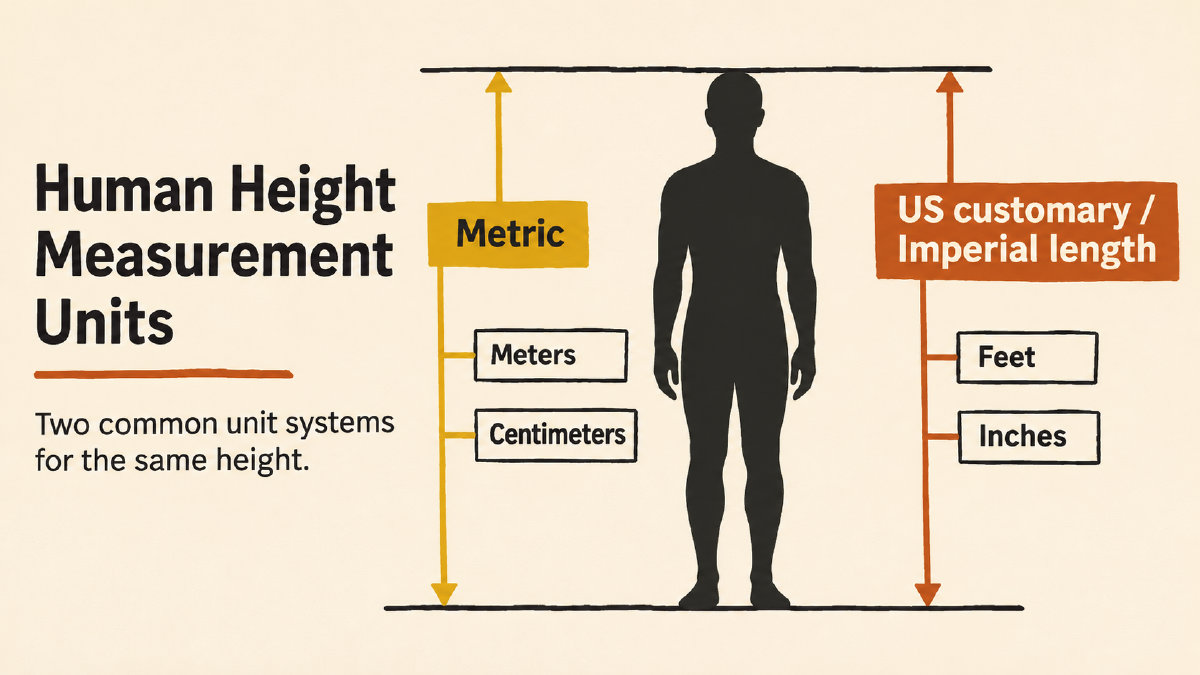
Height uses length to describe someone’s vertical size, so we’ll stick with that. Both systems use different units for describing human height. The metric system measures height using centimeters and meters; the imperial uses feet and inches. While the two systems share the same general concept of measuring length, the unit sizes differ significantly. Fortunately, the relationship between inches and centimeters has been standardized, allowing us to easily convert between them. One inch is exactly equal to 2.54 centimeters, which allows you to convert from inches to centimeters with relative ease. If you prefer, one foot is equal to 30.48 centimeters, while a modern yard is defined as being exactly 0.9144 meters.
So what’s the difference between the American system and British imperial?
It comes down to definitions. Before America gained independence from Britain, it used the English units that were commonly used across Britain and elsewhere. This created a number of different variations of related but distinct measurement systems. When America separated, however, the United States continued using its version of the English system. Today, the term “American” is often used interchangeably with “customary,” referring to the system of units adopted and used by the United States. Britain did eventually adopt the metric system, too, although some British units remain common. In fact, if you check out the UK government’s website, you’ll find that GOV.UK says people commonly describe their height in feet and inches, rather than in meters.
You could compare volumes of liquid. In fact, you already did! A liter is the basic unit of volume in the metric system, while gallons are the basis for imperial and American measurements. But the exact volume of a gallon differs slightly. You might remember that a US liquid gallon contains about 3.79 liters. An imperial gallon, though, contains about 4.54609 liters. Why the difference? Because they are separate measurements, derived from different standards and definitions.
Sources
Try the height tools
Compare two to ten people or convert a height precisely.
Compare heights →Height converter →Related articles
What Level of Measurement Is Height? Why It Uses a Ratio Scale
What level of measurement is height? Learn why numerical height uses a ratio scale, what true zero means, and when height categories are ordinal.
Read articleHow to Read Height Measurement in Mexico
Understand height measurement in Mexico through official metric units, decimal-meter examples, and the documented phrase “un metro 14.”
Read articleA Feet and Inches Calculator Excel Users Can Build on Windows
Build a feet and inches calculator in Excel for Windows with numeric inputs, total inches, height differences, and normalized feet-and-inches results.
Read article