How to Use the Feet and Inches to Meters Formula
Use the feet and inches to meters formula, work through a height example, and avoid confusing mixed measurements with decimal feet.
On this page
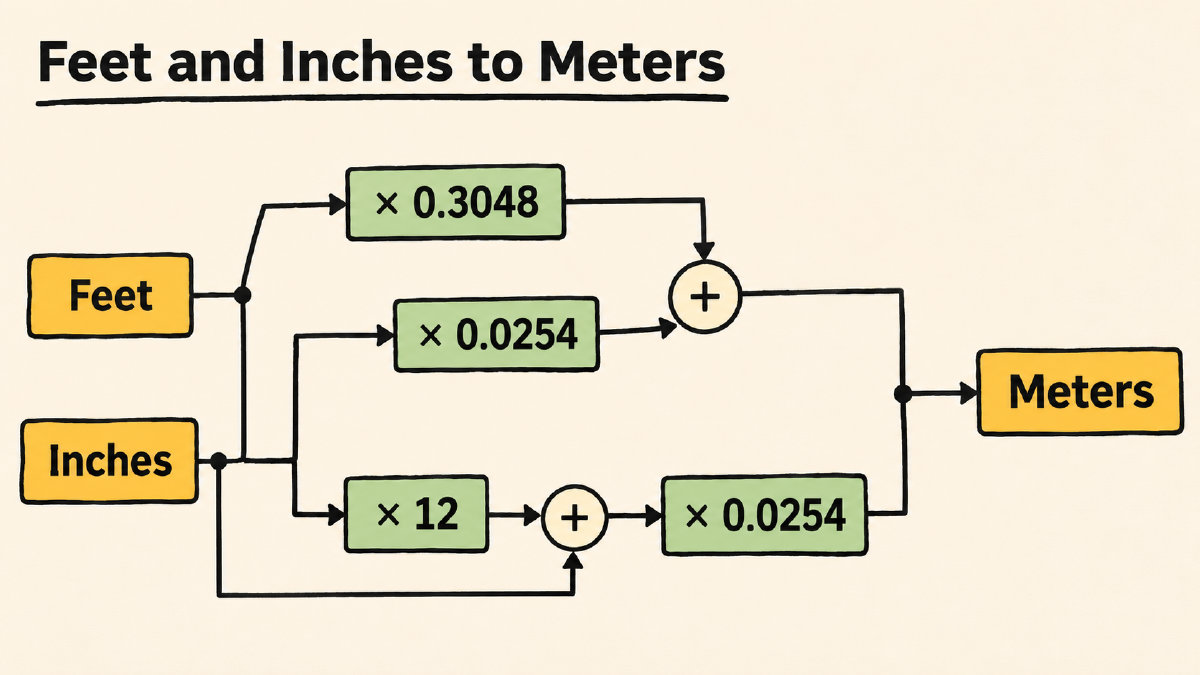
The feet and inches to meters formula, which can be expressed as:
meters = feet × 0.3048 + inches × 0.0254
or as:
meters = (feet × 12 + inches) × 0.0254
both refer to a single measurement, in feet and inches, converted into another unit: meters.
The difference between the two equations is that one equation takes the two separate components of a single measurement (feet and inches), while the other converts both to inches first before converting the total number of inches to meters.
Why the Formula Works
Why does it work? The equation works because an inch is 1/12 of a foot, or approximately 0.0833333 feet. Therefore, multiplying by 12 converts everything to inches. And then, since each inch is exactly 0.0254 meters, you simply multiply the total number of inches by that value. Alternatively, you can convert everything to feet, noting that 1 foot is equal to 12 inches, and then use the fact that 0.3048 meters is equal to 12 × 0.0254. Either approach will give the same result.
Let’s walk through a calculated height example, using total inches. If someone is 5 feet tall and 8 inches tall, we can express that as:
(5 × 12) + 8 = 68 inches
Then, convert those inches into meters:
68 × 0.0254 = 1.7272 m
Alternatively, if we take the 5 feet and the 8 inches separately, they are converted individually:
5 × 0.3048 = 1.524 m
8 × 0.0254 = 0.2032 m
Adding those gives us:
1.524 + 0.2032 = 1.7272 m
Depending on how precise we need to be, we can round the answer off, but otherwise, the calculation is correct. If we’re reporting this to two decimal places, we could report the answer as 1.73 m.
Mixed Feet and Inches Versus Decimal Feet
Now let’s compare mixed feet and inches with decimal feet. When a measurement is expressed in feet and inches, there’s a difference between twelfths and decimal fractions. In the previous example, 5 feet 8 inches is 5 + 8/12 feet, or 5.6667 feet, which is roughly what you’d expect.
But suppose the person measured was 5.8 feet tall instead. We could calculate their height in inches by subtracting the 5 feet from the total and then multiplying the remainder by 12:
0.8 × 12 = 9.6 inches
So that person would be 5 feet 9.6 inches tall. You might also express that as a decimal: 5.8 feet tall.
If you want to convert decimal feet into meters, you can do so by simply multiplying by the exact conversion factor:
meters = decimal feet × 0.3048
So in this case:
5.8 × 0.3048 = 1.76784 m
Again, we can decide to how many decimal places we want to represent our final answer, which is dependent upon the intended use of the information and the precision of the original measurement. If we wanted to report this to two decimal places, we would say the person is 1.77 m tall.
Working With a Fractional Inch
Fractional-inch input retains the whole inches component and its fractional part in the same formula.
A calculated example: 5 feet 8½ inches.
8½ inches = 8.5 inches
(5 × 12 + 8.5) × 0.0254 = 1.7399 m
In this case, the calculation is simple, since there is no fraction involved. But the equation still works just fine. There is no need to adjust anything in the formula, even when working with a fractional inch.
Exact Unit Factors and Measurement Precision
You can distinguish the exactness of the unit factors, versus the precision of the measurement itself. For example, the international foot is defined as exactly 0.3048 meters. This means that the unit factor for the foot is exact, which implies that we can consider 12 inches in a foot to be exactly 12 inches. That means that 1 inch is exactly 0.08333333… feet, and that 1 inch is exactly 0.0254 meters. These exact values allow for conversion without loss of accuracy.
Converting from feet and inches to meters, then, involves taking the measurement and converting it to either feet or inches. Multiplying by the appropriate unit factor gives the correct result.
There is some confusion about rounding when converting between units, however. As long as we understand that the unit factor is exact, we don’t have to increase the precision of the original measurement. Instead, we must maintain the precision of the original measurement and then only round at the end. If you were asked to provide your height to two decimal places, then you should convert to meters using the exact value and round the answer appropriately.
Sources
Try the height tools
Compare two to ten people or convert a height precisely.
Compare heights →Height converter →Related articles
What Level of Measurement Is Height? Why It Uses a Ratio Scale
What level of measurement is height? Learn why numerical height uses a ratio scale, what true zero means, and when height categories are ordinal.
Read articleHow to Read Height Measurement in Mexico
Understand height measurement in Mexico through official metric units, decimal-meter examples, and the documented phrase “un metro 14.”
Read articleA Feet and Inches Calculator Excel Users Can Build on Windows
Build a feet and inches calculator in Excel for Windows with numeric inputs, total inches, height differences, and normalized feet-and-inches results.
Read article