Should You Report Your Height Without Shoes?
Use height without shoes as a clear reporting baseline, label measurements taken in shoes, and avoid guessing a barefoot value.
On this page
There’s a question I’ve received several times from readers of my blog, and I’ve never really addressed it. I think the reason is because it seems so obvious to me that there’s no need for clarification. But since I’m getting asked this more frequently now, I thought I’d address it.
I don’t know if there’s an official standard on this, but in the everyday world where we interact with each other, I think the answer is pretty clear. When you say something like “I’m 5’10”,” you’re talking about your standing height without shoes. If you wanted to include your shoes, you would have said something like “I’m 5’10” including shoes.”
Reporting Height Without Shoes on Forms
But just to be thorough, let’s explore some possibilities. First, there are forms where you’re told specifically to report your height without shoes. In those cases, obviously, you should do that. If you’re filling out a form and it says “Height (without shoes):”, then obviously you should provide a barefoot measurement.
If you’re filling out a form that doesn’t specify whether or not you should remove your shoes before measuring, then you can ask for clarification. If you’re uncertain about how to interpret the form, then asking for clarification is always better than making an assumption.
Height in Casual Conversation
However, when it comes to casual conversation, I think the answer is still pretty clear. If someone asks, “How tall are you?” and you respond, “I’m 5’10”, they’ll understand that you’re referring to your height without shoes. If you wanted to include your shoes, you would have said something like, “I’m 5’10’ including shoes.” Or maybe even “My shoe-inclusive height is 5’10””.
So again, unless you’re instructed otherwise, I don’t see any problem with assuming that people are referring to their height without shoes when they give their height in a casual setting. If you’re comparing measurements, I’d label them “measured barefoot” or “measured wearing shoes.” Use barefoot measurements for everyone if you’re comparing barefoot height. If you don’t know how someone was measured, leave that uncertainty clear.
Entering Your Height on Websites
Now, what about websites? What if a website says “Please enter your height in inches,” and then later says “Shoes removed”? Well, if you look at the wording, it’s probably telling you how to measure yourself, rather than telling you how to report your height. So if you’re entering your height in inches, and you remove your shoes before measuring, then obviously you should enter your barefoot height.
However, if you’re entering your height into a form that doesn’t specify whether or not you should remove your shoes, then again, you should ask for clarification. There’s no harm in asking, and it might save you some embarrassment down the road if you assume the wrong thing.
Medical Forms and Measurement Instructions
On the other hand, if you’re entering your height as part of a medical form, then obviously you should follow the instructions given by the doctor or clinic. Those folks are trained to take measurements properly, and they know exactly how to interpret the data.
In fact, the CDC has standardized anthropometric procedures that they use to collect and compare local measurements to national reference data. They even have specific guidance for measuring height.
The available CDC text does not establish the specific posture or clothing instructions for measuring height.
Taking a Barefoot Measurement
For a barefoot measurement, remove your shoes before measuring and follow the existing home-and-clinic measurement guide for positioning yourself. If you only have a measurement taken in shoes, you can’t know your exact barefoot height without knowing how much those shoes added. Don’t subtract a fixed amount; take a barefoot measurement using the guide.
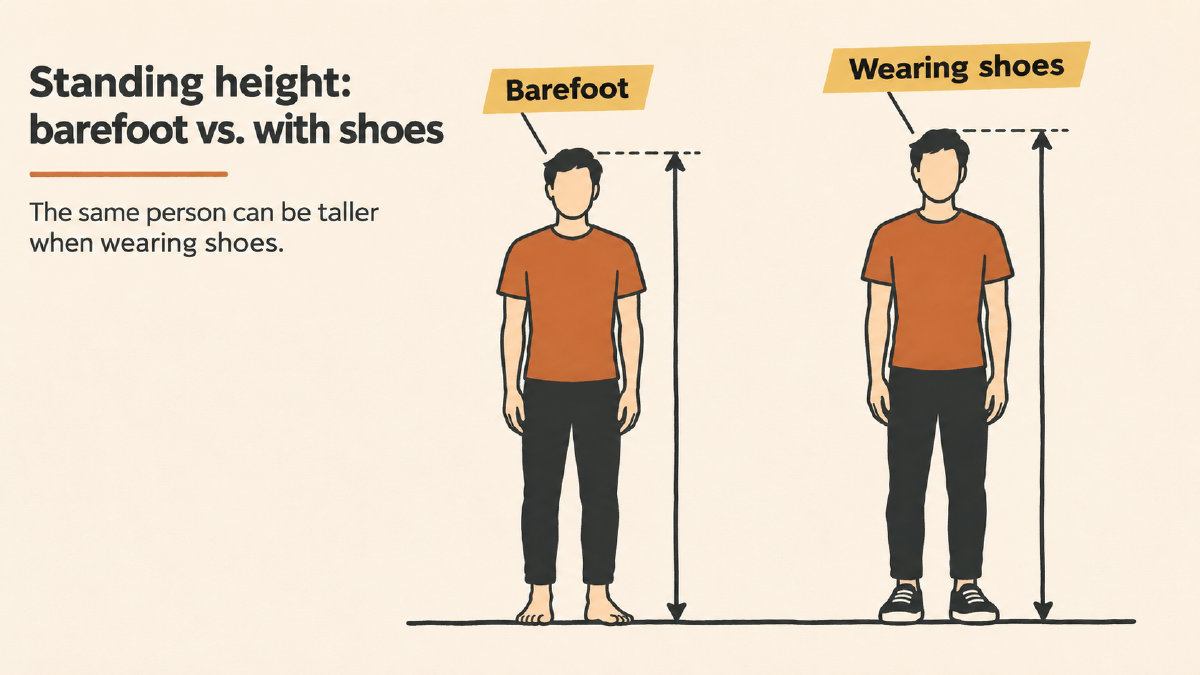
A medical setting alone doesn’t establish whether your height will be measured barefoot. Follow the doctor or clinic’s measurement instructions, and ask for clarification if they don’t specify whether to remove your shoes.
But again, when it comes to casual conversation, I don’t think anyone expects you to be measured while barefoot. We all know that when we talk about our height, we mean our standing height without shoes. And if you want to include your shoes, you’ll say so.
Sources
Try the height tools
Compare two to ten people or convert a height precisely.
Compare heights →Height converter →Related articles
What Level of Measurement Is Height? Why It Uses a Ratio Scale
What level of measurement is height? Learn why numerical height uses a ratio scale, what true zero means, and when height categories are ordinal.
Read articleHow to Read Height Measurement in Mexico
Understand height measurement in Mexico through official metric units, decimal-meter examples, and the documented phrase “un metro 14.”
Read articleA Feet and Inches Calculator Excel Users Can Build on Windows
Build a feet and inches calculator in Excel for Windows with numeric inputs, total inches, height differences, and normalized feet-and-inches results.
Read article